
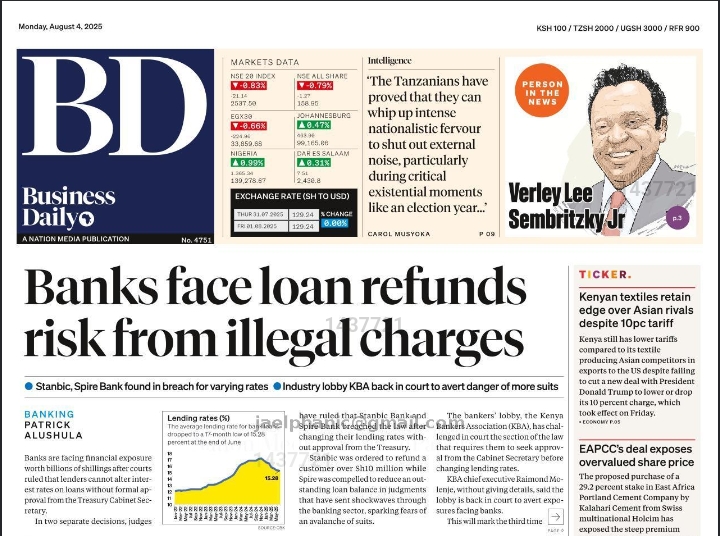
Summary Of The Business Daily Newspaper -Aug 04,2025
Page 1: Reports indicate Kenyan banks, including Stanbic and Spire Bank, face financial risks after courts ruled altering loan interest rates without Treasury approval illegal, potentially requiring billions in refunds. The Kenya Bankers Association is challenging the law to curb lawsuits, causing sector-wide concern. Unrelated updates note Kenya’s textile industry outperforms Asian rivals despite tariffs and a disputed share valuation in an EAPCC deal.
Page 2: Notes reveal the KRA is blocking the ex-Java House owner from leaving over a Sh3 billion tax dispute, involving unpaid corporation tax and sale proceeds. ECP Kenya, the firm involved, filed for insolvency, citing Sh3.3 billion losses and no operations since 2023, while the KRA demands tax recovery before liquidation. The parent company, ECP Manager LP, plans to exit Kenya by April 2024 due to financial unsustainability.
Page 4: Updates show analysts predict a modest weakening of the Kenyan shilling to 132 against the dollar by December 2025, driven by budget deficits and rising US Treasury yields. Divergent forecasts range from 155 (Capital Economics) to 132–133 (Fitch Solutions), though the decline is less severe than 2018’s 152. Pressure stems from narrowing interest rate differentials and investor shifts to dollar assets.
Page 5: Reports highlight Kenya’s textile industry maintains a US market edge despite 10% tariffs, as Asian rivals like Bangladesh and Vietnam cut rates from higher levels. Meanwhile, the Auditor General exposed Rerec’s illegal diversion of Petroleum Development Levy funds for electrification projects, worsening fuel price instability. The misuse raises accountability concerns over levy governance.
Page 6: Notes detail a court ruling against Bridge International’s ex-Finance Director, Steve Onyango, for negligence in Sh63.7 million M-Pesa fraud, including duplicate payments. The court upheld his dismissal, citing his oversight failures, with a KPMG report linking losses to departmental weaknesses under his watch.
Page 7: Updates reveal a premium in Kalahari Cement’s bid for a 2023% EAPCC stake, with shares priced at $1,272/unit ($10.46B deal) against a market cap of $84.57B—below net asset value ($102.04B). EAPCC’s stock surged 60.5% in a year, signaling investor confidence despite valuation gaps, suggesting the firm may be undervalued.
Page 10: Reports warn KWS’s plan to double park fees risks alienating locals, threatening domestic tourism growth and conservation efforts tied to public engagement. Advocates urge affordable options like resident discounts and school packages to foster generational connections to wildlife.
Page 14: Notes show Kenya’s Sugar Development Levy (SDL) idle funds will be invested in Treasury bills, bonds, and call deposits, indicating low uptake for factory upgrades or grower support. The 4% levy on local/imported sugar aims to address industry crises like cane shortages and Sh23B imports in 2023.
Page 23: Updates introduce TU AI, a Nairobi-developed tool simplifying tender applications via AI, offering search, compliance, and Swahili translation features. It targets young entrepreneurs by streamlining bureaucratic processes, boosting inclusivity in public/private procurement.
Page 24: Reports note Kenyan SMEs seek PE funding for expansion, but legal/tax gaps deter investors despite commercial potential. Experts advise improved compliance, transparent finances, and structured deals to attract capital while balancing founder control.