Summary Of The Business Daily Newspaper -Aug 06,2025
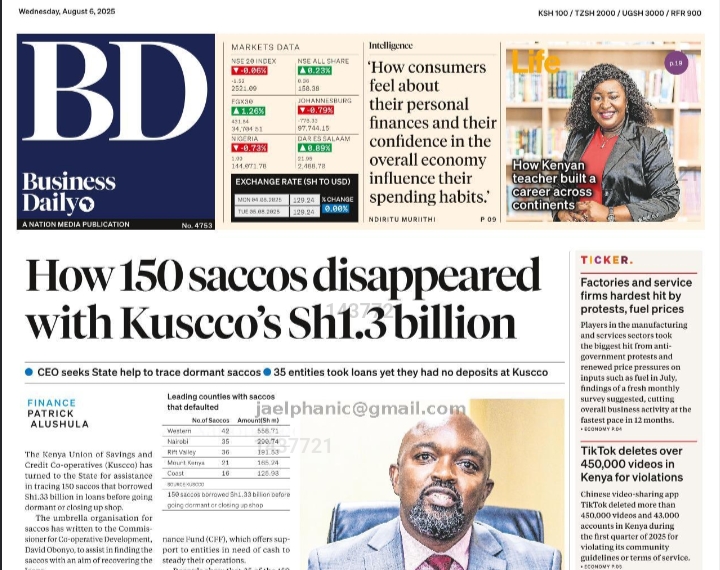
Page 1: Reports indicate that Kuscco is seeking government help to trace 150 dormant saccos that borrowed Sh1.33 billion, with 35 having no deposits. The organization, already facing a Sh13.3 billion loss from past misconduct, aims to recover funds, noting Western County leads in defaults. Efforts are underway to address financial challenges and reclaim outstanding loans.
Page 2: Notes show Kenya’s forex reserves dropped by Sh65 billion due to external debt repayments, including a Sh55 billion payment to China for SGR loans. Moody’s warns continued repayments 3% of GDP could strain reserves or force new borrowing without multilateral support. The CBK maintains stability efforts, but Treasury dollar conversions further deplete reserves.
Page 4: The EACC identifies Kenya’s most corrupt offices, with TSC, Labour Ministry, NSSF, KWS, and Treasury having 100% bribery rates. Other high-risk institutions include NG-CDF, assistant county commissioners, and Public Works. The report highlights exorbitant bribery demands crippling service delivery nationwide.
Page 5: Notes that TikTok removed 450,000 videos and 43,000 accounts in Kenya for guideline violations, with 92.1% taken down before viewing. Meanwhile, MCAs must now contribute to NSSF, with employers matching payments, as part of pension reforms.
Page 6: Reports that the Environment Court blocked KFS from seizing Jeremy Block’s 1,078-acre land near Karura Forest pending a boundary appeal. Separately, NSE shareholders demand an EGM over governance issues, with the board agreeing to meet. The CMA stresses transparency in resolving disputes.
Page 7: Notes that the High Court dismissed petitions against Kebs’ Sh1 billion PVOC tender, allowing the award to proceed. Turkish firms TUV Austria Turk and TIC Quality Control lost on technical grounds, with the judge ruling they lacked standing. Kebs can now finalize the 2025-28 inspection contract.
Page 13: Kenya faces a growing Mpox outbreak, with 300 cases in 23 counties, exposing gaps in preparedness and vaccine reliance. The BioVax Institute, established in 2021, has yet to produce doses, leaving Kenya dependent on imports. Urgent needs include better surveillance and local vaccine production.
Page 14: Reports that the Acorn Holdings cut its debt interest rate from 16.3% to 11.1% by refinancing loans amid falling rates. The I-Reit reduced borrowings from Sh2.65 billion to Sh1.91 billion, benefiting from lower T-bill rates (now 8.4%). Improved liquidity and favorable terms drove the savings.
Page 19: Profiles Audrey Ashlali overcame teenage motherhood and a C+ in KCSE to build a global teaching career. After pivoting from law to education, she earned her degree, moved to Bahrain, and made her first million at 26. She now teaches in Moscow, exemplifying resilience.
Page 21: Kenyans’ reliance on cybercafés for sensitive tasks like tax filing exposes major data privacy risks. Despite smartphone access, many trust unregulated operators with IDs, KRA pins, and financial data. The trend highlights urgent gaps in data protection awareness.
Page 24: Reports that AfCFTA could boost Africa’s economy, but uneven development and stagnant businesses pose challenges. MSMEs are seen as key, with proposals like digital transformation and financial diversification to enhance competitiveness. Success depends on localizing policies and cutting connectivity costs.