
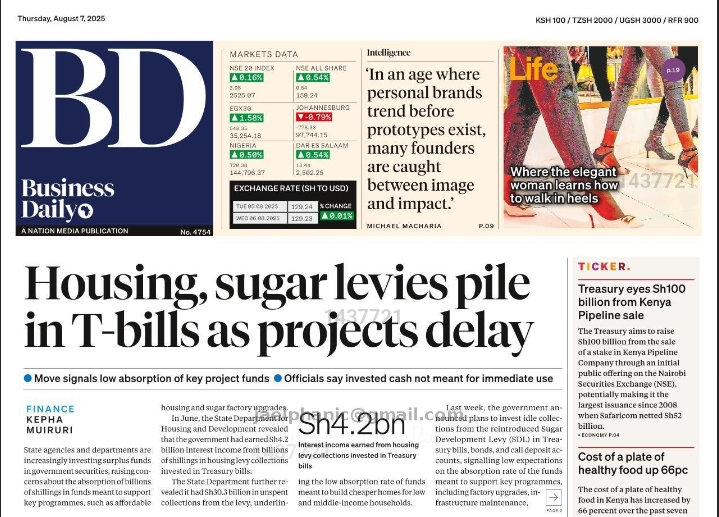
Analysis Of Tone and Perspective Review Of The Business Daily Newspaper -Aug 07,2025
TONE
The tone of The Business Daily on August 7, 2025, is predominantly critical and concerned, particularly regarding government inefficiencies and economic challenges. While it acknowledges positive developments like trade deals and privatization efforts, skepticism lingers over fund mismanagement, rising living costs, and regulatory debates. A sense of urgency underscores issues like food affordability and alcohol abuse, balancing factual reporting with calls for intervention.
TRACK
The newspaper’s coverage follows a consistent track of scrutinizing fiscal policies, trade dynamics, and corporate governance, reflecting Kenya’s economic priorities. It highlights both state-led initiatives (e.g., KPC privatization, China trade deal) and systemic failures (e.g., unspent levies, Rivatex’s decline). The focus on AI and family business trends shows an effort to blend immediate economic concerns with forward-looking analysis.
FRAMING
Stories are framed around accountability (e.g., unused housing funds), opportunity (e.g., export deals, privatization), and crisis (e.g., food affordability, alcohol poisoning). The state is often portrayed as either underperforming or recalibrating, while private sector solutions (e.g., Rivatex lease, AI adaptation) are emphasized. Human impact such as diet affordability is used to ground macroeconomic discussions in everyday struggles.
EDITORIAL AGENDA
The editorial agenda prioritizes fiscal transparency, private sector growth, and social welfare, advocating for efficient resource use and market-driven reforms. Critiques of state agencies and NACADA regulations suggest a preference for pragmatic, evidence-based policymaking over bureaucratic control. The inclusion of global trends (AI, family businesses) aligns with a vision of Kenya integrating into broader economic and technological shifts.
CONCLUSION
The Business Daily presents a nuanced narrative of Kenya’s economy, blending critique with cautious optimism about reforms and external partnerships. It underscores persistent governance gaps while championing privatization, trade diversification, and adaptive business strategies. Ultimately, the paper calls for balanced, actionable solutions to bridge policy intentions and public welfare outcomes.