Summary Of The Business Daily Newspaper -Aug 07,2025
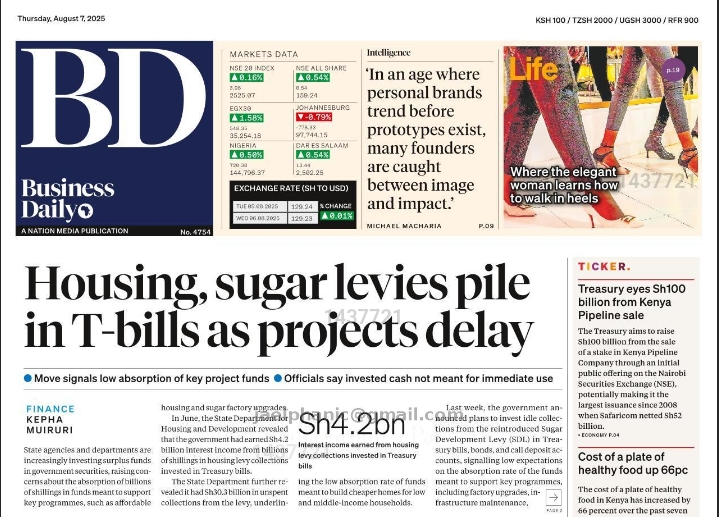
Page 1: Reports indicate that Kenyan state agencies are investing surplus funds, including housing and sugar levies, in government securities, raising concerns about low absorption for critical projects. The State Department for Housing earned Sh2 billion in interest from unspent levy funds, with Sh30.3 billion remaining unused, highlighting delays in affordable housing and sugar factory upgrades. This signals skepticism about timely utilization of funds for intended purposes.
Page 2: Notes reveal Kenya is close to a trade deal with China to eliminate tariffs on agricultural exports, despite tensions with allies and U.S. scrutiny over human rights and Sudan ties. The trade deficit with China widened to Sh549.8 billion in 2023, prompting Kenya to boost exports through marketing campaigns and trade centers in China. President Ruto hailed the agreement as a breakthrough for tea, coffee, and avocado exports.
Page 3: Details show Kenya plans to raise Sh100 billion by selling a 65% stake in Kenya Pipeline Company (KPC) via an IPO, the largest since Safaricom’s 2008 listing. The Cabinet-approved move aims to boost revenue and unlock KPC’s potential, with Uganda invited to participate to counter Tanzania’s regional competition. The Treasury projects higher returns despite the government retaining only a 35% stake.
Page 5: Findings highlight a 66% surge in the cost of a healthy diet in Kenya since 2017, leaving 77% of Kenyans unable to afford nutritious meals in 2024. Rising costs force reliance on cheaper, less nutritious alternatives, worsening diet-related health crises. The UN survey underscores urgent need for interventions to improve food affordability and access.
Page 6: Reports state Kenya will lease Rivatex East Africa to a private investor for 21 years to revive the struggling textile firm. Operating below 5% capacity due to financial woes, the move aims to leverage private expertise, support local farmers, and reduce public funding reliance. President Ruto expects the deal to be finalized soon.
Page 7: Notes confirm Kenya Power paid Sh1.96 billion to Ormat Technologies to reduce overdue geothermal power bills, cutting the balance from Sh5.78 billion. Ormat, supplying 150 MW, cited Kenya as a key market, contributing 12.1% of Q1 2025 revenues. Kenya Power’s improved profits and government backing bolster confidence in full debt recovery.
Page 10: Discussions intensify over NACADA’s proposed alcohol regulations, balancing abuse prevention with economic and creative industry impacts. Illicit alcohol, 60% of consumption, drives poisoning cases, costing Kenya Sh37 billion annually. Critics advocate for education and tax-funded solutions over heavy-handed restrictions.
Page 14: Reports indicate Shelter Afrique delayed its $500 million bond to 2026 due to high-interest rates, aiming to strengthen investor confidence first. The pan-African bank plans tranched issuances in East Africa to mitigate forex risks, alongside a $100 million West African bond. A recent rating upgrade seeks better pricing for housing project funding.
Page 22: Analysis shows AI answer engines like ChatGPT are shifting visibility from SEO to Answer Engine Optimization (AEO), requiring structured, machine-readable content. Businesses must adapt by crafting clear, query-focused responses for AI recommendations. This prioritizes clarity over keyword tricks as AI becomes a discovery gateway.
Page 24: Highlights reveal family businesses, contributing $8.8 trillion globally, are transitioning to younger leaders open to mergers and private equity partnerships. Unlike older generations favoring organic growth, successors seek expansion via strategic deals. Tax efficiency and adaptability are key to navigating this generational shift.