
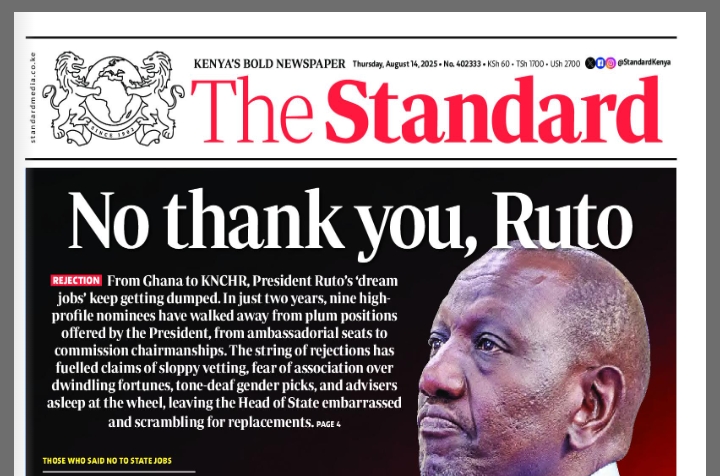
Analysis Tone and Perspective Review Of The Standard Newspaper
TONE
The tone across the pages is predominantly critical and investigative, particularly in coverage of political and governance issues, such as President Ruto’s nomination rejections and corruption scandals. Some pieces adopt a neutral, factual tone, especially in reporting financial news (e.g., KCB’s profits) and sports updates, while others carry a slightly sensationalist edge, particularly in stories about large jackpot wins or political feuds. The tone shifts to urgent and cautionary in reports on legal disputes, security crackdowns, and governance failures, emphasizing accountability and public concern.
TRACK
The coverage tracks recurring themes of governance failures, political instability, and institutional dysfunction, particularly in Kenya’s leadership and public administration. It also follows economic and financial developments, highlighting corporate successes (like KCB) alongside controversies (such as the Nairobi-Mombasa Expressway dispute). Additionally, the reporting maintains a steady focus on sports, both domestic and international, balancing achievements with organizational shortcomings (e.g., FKF’s fines).
FRAMING
Most political and governance stories are framed as crises, emphasizing dysfunction (e.g., rejected nominations, county feuds, police brutality) to underscore systemic problems. Economic and business reports are framed as progress narratives (e.g., KCB’s profits) or conflict-driven (e.g., the expressway dispute), shaping public perception of stability versus controversy. Sports coverage is framed competitively, either celebrating Kenya’s athletic prowess or critiquing administrative failures, reinforcing national pride alongside calls for reform.
EDITORIAL AGENDA
The editorial agenda prioritizes scrutiny of political leadership, particularly President Ruto’s administration, with repeated emphasis on corruption, mismanagement, and declining public trust. It also promotes financial and business accountability, balancing success stories with investigative critiques of major projects and corporate governance. Additionally, the agenda highlights sports as both a national achievement and a reflection of systemic flaws, ensuring a mix of celebration and criticism to engage diverse readership interests.
CONCLUSION
The coverage collectively paints a picture of a nation grappling with political instability, economic contrasts, and sporting excellence, reflecting both Kenya’s challenges and its resilience. While the tone varies from critical to celebratory, the underlying editorial stance demands accountability and reform across governance, business, and sports sectors. Ultimately, the reporting serves as a mirror to Kenya’s complex socio-political landscape, balancing exposé with optimism in equal measure.