
TONE
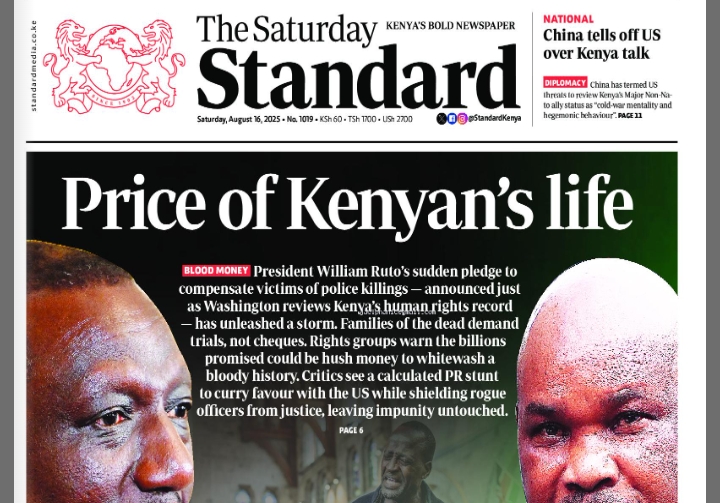
The tone of The Standard on August 16, 2025, is largely critical and investigative, scrutinizing government actions with skepticism. It adopts a confrontational stance toward political maneuvers, particularly President Ruto’s compensation plan and privatization agenda, framing them as insincere or flawed. However, it balances this with a respectful, commemorative tone in covering figures like Sudhir Vidyarthi, highlighting contributions to democracy and social causes.
TRACK
The newspaper tracks governance failures, human rights concerns, and systemic inefficiencies, emphasizing accountability gaps in both national and county leadership. It also follows socio-economic issues like healthcare crises (cervical cancer, neonatal care) and financial mismanagement (pension defaults, wasteful conferences). Additionally, it monitors legal and electoral reforms, sports achievements, and aviation safety, presenting a broad but critical overview of national affairs.
FRAMING
Stories are framed to underscore government shortcomings, portraying policies like Ruto’s police brutality compensation as politically motivated rather than justice-driven. Health and labor issues are framed as systemic neglect, with cultural barriers and nurse shortages depicted as preventable crises. Meanwhile, impeachment debates and privatization halts are framed as battles between public interest and opaque governance, reinforcing a narrative of institutional dysfunction.
EDITORIAL AGENDA
The editorial agenda prioritizes exposing perceived government failures, advocating for transparency, and amplifying marginalized voices (victims’ families, nurses, artists). It critiques fiscal irresponsibility (e.g., Sh200M conferences) while championing judicial and electoral reforms as necessary checks on power. The paper also celebrates historical figures and athletic achievements, blending criticism with cultural pride.
CONCLUSION
The Standard’s August 16 edition serves as a watchdog, dissecting power dynamics with a focus on accountability and public welfare. Its blend of investigative rigor and human-interest storytelling reinforces its role as a critic of governance while celebrating national resilience. The paper ultimately positions itself as a voice for systemic change, demanding justice, efficiency, and integrity in Kenya’s institutions.