
Summary Of The Business Daily Newspaper -Aug 18,2025
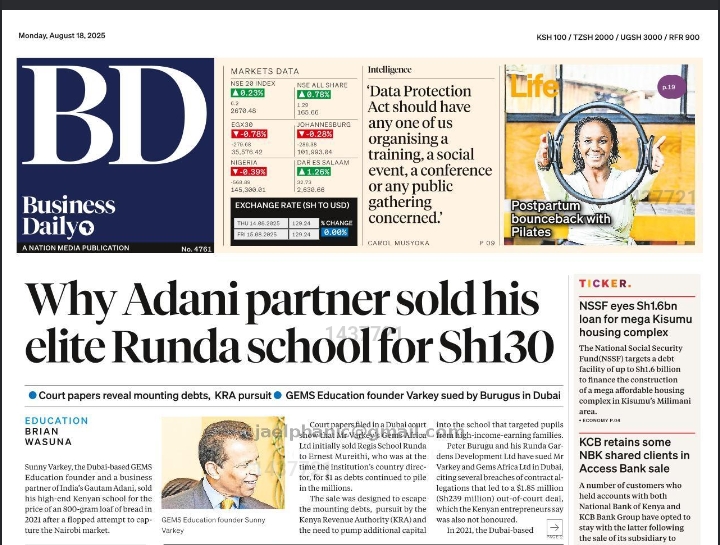
Page 1: Reports reveal that Sunny Varkey, founder of GEMS Education and a business partner of Gautam Adani, sold his high-end Kenyan school in 2021 for a nominal price after failing to capture the Nairobi market. The sale, likened to the cost of an 800-gram loaf of bread, highlights the financial struggles and mounting debts faced by the Dubai-based entrepreneur.
Page 2: Rising global fuel costs led to significant price increases for petrol and diesel in Kenya, with the government collecting Sh26.37 billion from the petroleum development levy in the year to June 2025. Despite subsidies stabilizing diesel and kerosene prices, higher fuel costs contributed to inflation reaching its highest level since August 2022, prompting the state to seek additional funds to ease the burden on consumers.
Page 3: Reports that the National Social Security Fund (NSSF) plans to secure an $11.6 billion debt facility to build a 162-unit affordable housing complex in Kisumu, with the project’s loan-to-value ratio set at 65%. This follows another major NSSF project a mixed-use complex in Nairobi’s CBD on a long-disputed 3.85-acre plot which will be developed under an engineering, procurement, construction, and finance model.
Page 4: Reports that a court has ordered an independent valuation of properties tied to an Sh826 million loan dispute between NCBA Bank and road contractor Westbuild General Contractors, after conflicting valuations emerged (Sh670 million vs. Sh485 million). While allowing the bank to proceed with auction plans, the judge mandated detailed loan account statements to resolve the borrower’s claim that the outstanding debt is only Sh167 million, not Sh826.7 million as asserted by NCBA.
Page 6: Reports indicate that some customers of National Bank of Kenya (NBK) chose to remain with KCB Bank after NBK’s sale to Nigeria’s Access Bank, which was finalized in May 2025 at 1.25 times NBK’s book value. KCB retained certain assets and liabilities from the deal, enabling it to declare a special dividend, while Access Bank expanded its Kenyan presence with this second acquisition following its 2020 entry into the market.
Page 10: Reports highlight how climate change and health challenges are increasingly intertwined in Africa, with climate-related disasters exacerbating disease spread and straining healthcare systems, as discussed at the upcoming AfyaFest 2025 in Nairobi. The event aims to showcase local health innovations from digital tools to climate-smart solutions while fostering cross-border collaboration to build resilient healthcare systems across the continent.
Page 14: Reports show Kenyan fund managers more than doubled offshore investments to Sh50.2 billion by June 2025, driven by higher returns and greater liquidity in foreign markets compared to local options. This surge has made offshore assets including stocks, gold, and ETFs the fourth most popular investment class, with specialized multi-asset funds increasingly focusing on these opportunities.
Page 19: Reports indicate Kenyan fund managers more than doubled offshore investments to Sh50.2 billion by June 2025, as foreign stocks, gold, and ETFs offered higher returns and greater liquidity than local markets. This 161% growth has made offshore assets the fourth most popular class, spurring specialized multi-asset funds to capitalize on these opportunities.
Page 20: Profiles Jacqui Wangari, a 40-year-old mother of three, credits her toned post-maternity physique to a disciplined Pilates and strength training regimen, combined with a strict diet. As she prepares to celebrate her birthday in September, the Nyari Estate resident remains committed to her fitness goals while balancing motherhood with her health routine.
Page 24: Reports Kenya faces a growing housing deficit of over 2 million units, with annual demand increasing by 200,000, yet developers struggle to secure long-term financing beyond expensive debt options. Development Real Estate Investment Trusts (DREITs) could bridge this gap by providing equity funding for large-scale projects, though regulatory and tax hurdles must first be addressed to unlock their potential in transforming Kenya’s capital markets.