
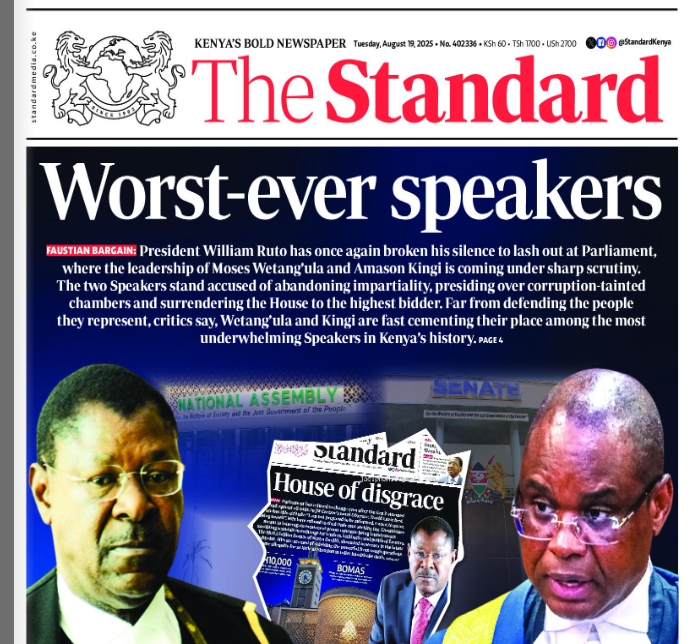
Analysis Tone and Perspective Review Of The Standard Newspaper -Aug 19,2025
TONE
The tone of The Standard’s roundup is predominantly critical and investigative, highlighting systemic failures, corruption, and governance lapses. It adopts a matter-of-fact yet urgent voice when addressing issues like political misconduct, gender disparities, and institutional mismanagement. While some sections celebrate achievements (e.g., sports), the overall tone leans toward holding power to account, often with a hint of disillusionment.
TRACK
The newspaper consistently tracks themes of accountability, social justice, and institutional reform, as seen in its coverage of corruption in Parliament, mismanagement in public agencies, and court rulings on rights violations. It also monitors equity issues, such as gender gaps in education and intersex rights, reflecting a focus on marginalized groups. The recurring emphasis on legal and political scrutiny suggests a commitment to watchdog journalism, though with occasional partisan undertones (e.g., ODM-UDA tensions).
FRAMING
Stories are framed to emphasize conflict and systemic dysfunction, such as framing Parliament as corrupt or the Geothermal Development Company as wasteful. Achievements (e.g., sports victories, judicial reforms) are presented as exceptions to broader struggles, reinforcing a narrative of resilience amid challenges. The framing often pits public interest against elite malfeasance, positioning the paper as a voice for accountability.
EDITORIAL AGENDA
The editorial agenda prioritizes exposing corruption, advocating for institutional transparency, and amplifying marginalized voices (e.g., nurses, intersex individuals). It pushes for legal and policy reforms, as seen in calls for anti-smuggling measures or judicial recruitment. While balanced in covering diverse topics, the agenda subtly critiques the government’s shortcomings, aligning with a reformist, pro-accountability stance.
CONCLUSION
The Standard’s roundup serves as a critical mirror to Kenya’s socio-political landscape, blending investigative rigor with advocacy for equity and justice. Its tone and framing underscore systemic challenges while sporadically celebrating national triumphs, creating a nuanced narrative. Ultimately, the paper positions itself as a catalyst for change, urging readers to confront corruption and inequality while acknowledging incremental progress.