
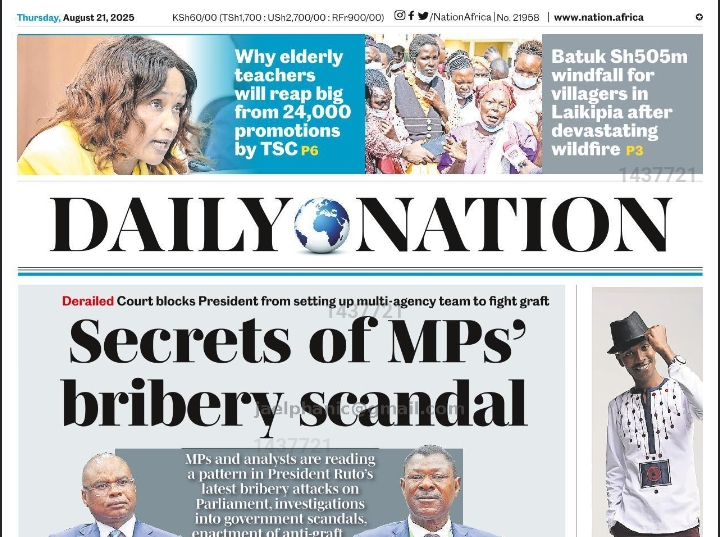
Analysis Tone and Perspective Review Of The Daily Nation Newspaper
TONE
It is predominantly critical and investigative, focusing on exposing governance failures and institutional corruption. It adopts a stance of public advocacy, particularly in highlighting scandals and social injustices affecting ordinary citizens, such as the water crisis and unpaid workers. However, this is balanced with a tone of measured reporting on international affairs and developmental issues, avoiding overt sensationalism in favor of factual presentation.
TRACK
The selection of stories, reveals a clear editorial priority on political accountability and social welfare. The lead stories meticulously track a central narrative of a government under intense internal and external pressure, weaving together the bribery scandal, US probe, and strategic reforms into a cohesive political saga. This main thread is consistently supported by complementary tracks on corruption in other institutions (KNH), sub-national governance crises (county strikes, impeachments), and the tangible human impact of these failures, creating a comprehensive picture of a nation grappling with systemic challenges.
FRAMING
The newspaper consistently positions events within a context of power dynamics and consequence for the public. Stories are framed not as isolated incidents but as symptoms of broader systemic issues corruption is framed as a betrayal of public trust, international engagements are framed through the lens of national interest, and local crises are framed as results of elite impunity. This approach encourages readers to view events as interconnected, emphasizing the accountability of leaders and institutions to the citizenry rather than treating news as discrete, unrelated happenings.
EDITORIAL AGENDA
Champions transparency, good governance, and social justice as paramount national interests. It aggressively pursues an agenda of holding power to account, demonstrated by its front-page focus on high-level scandals and its diligent tracking of corruption stories across multiple sectors and pages. Furthermore, the agenda extends to giving voice to marginalized groups, as seen in the coverage of striking workers, victims of environmental damage, and the summit on women’s leadership, positioning the newspaper as a platform for advocacy and reform.
CONCLUSION
The Daily Nation presents itself as a crucial watchdog institution, deeply engaged in the political and social currents of the nation. Its coverage constructs a compelling narrative of a country at a crossroads, facing significant challenges from corruption and poor governance, while also acknowledging strategic international engagements and cultural triumphs. Ultimately, the newspaper’s August 21st edition serves as a robust critique of the status quo, advocating for accountability, reform, and a more equitable distribution of justice and opportunity for all Kenyans.