
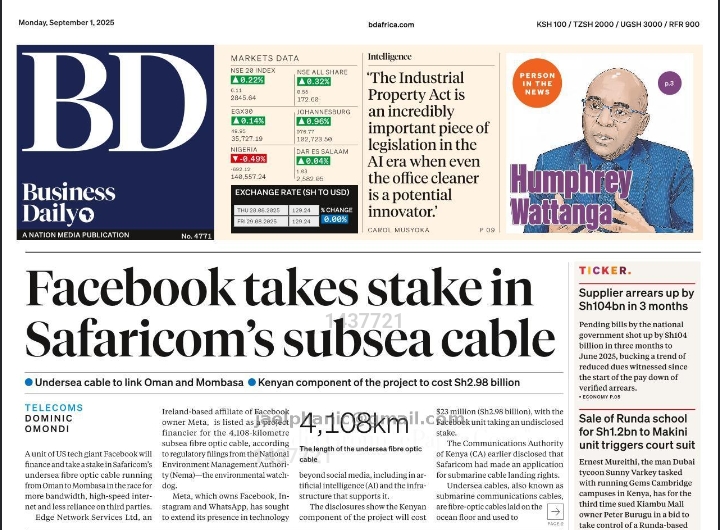
Summary Of The Business Daily Newspaper
Page 1: Reports indicate that an affiliate of Meta (Facebook’s parent company) will finance and take a stake in a new undersea fiber optic cable being developed by Safaricom, which will link Oman to Mombasa, Kenya. The Kenyan component of this 4,108-kilometer project is estimated to cost $23 million for Meta’s share. The initiative aims to provide more bandwidth, high-speed internet, and reduce reliance on third-party infrastructure.
Page 2: Reports show that the growth of Kenya’s payroll tax collections slowed to just 1.05% in the financial year ending June 2025, the weakest pace since the COVID-19 pandemic. This minimal increase in Pay-As-You-Earn (PAYE) receipts points to significant challenges in the job market, including a struggle to create new opportunities and raise wages. The data reflects a sharp reversal from previous years’ double-digit growth, coinciding with a notable drop in formal sector job creation.
Page 4: Reports indicate that the National Land Commission (NLC) has been ordered to resolve a dispute over a 6.4-acre parcel of land in Mombasa, where 41 different parties are claiming ownership and seeking government compensation. The land was earmarked for compulsory acquisition for two major infrastructure projects: the Mombasa Southern Bypass and a link to the Standard Gauge Railway (SGR). The tribunal has directed the NLC to conduct an inquiry to identify the genuine owner and settle the competing claims.
Page 5: Reports indicate that Kenya’s export earnings fell by 3.06% in the first half of 2025, marking the first decline in six years and widening the trade deficit to Sh783.91 billion. The drop was primarily driven by a double-digit contraction in tea sales, a key agricultural export, due to reduced volume and value. This decline highlights the country’s vulnerability to fluctuations in international commodity markets and its reliance on a narrow range of export goods.
Page 6: Reports show that the UK-based Institute of Risk Management (IRM) has established its African subsidiary, named Risk Management Hub Africa, in Nairobi. The new office aims to serve professionals, organizations, and governments across the continent, with a focus on sectors like financial services amid rising cross-border risks such as cybersecurity. This expansion reflects a growing attention to enterprise risk management among African firms.
Page 7: Reports indicate that the National Treasury plans to create new shares in the Kenya Pipeline Company (KPC) to raise Sh100 billion through an initial public offering (IPO). The strategy aims to broaden public ownership by offering affordable stock, mirroring the successful approach used in the Safaricom IPO. The government will amend the company’s articles of association to allow for the issuance of these new shares in addition to selling part of its existing stake.
Page 10: Reports argue that current climate action and restoration efforts often overlook the critical role of biodiversity, focusing too narrowly on metrics like the number of trees planted. The author emphasizes that true ecosystem restoration requires reviving the entire web of life including pollinators, soil microbes, and native species to ensure resilience and functionality. The piece calls for integrated approaches that combine carbon and biodiversity credits, prioritize native species and traditional knowledge, and support the social and economic benefits for local communities.
Page 14: Reports indicate that the Kenyan government exceeded its domestic borrowing target by more than three times, reaching Sh854.5 billion against a target of Sh263.2 billion for the year ending June 2025. This aggressive borrowing crowded out the private sector, resulting in negligible credit growth of only 2.2 percent for households and businessesv.The situation was exacerbated by commercial banks preferring to lend to the state via Treasury bills and bonds, starving the private sector of much-needed credit amid high interest rates.
Page 24: Reports warn that Kenya’s apparel industry faces imminent collapse if the African Growth and Opportunity Act (Agoa) is not renewed before its expiration on September 30, as the trade deal provides essential duty-free access to the US market. The article stresses that without Agoa, Kenya cannot compete with manufacturing hubs like Bangladesh and Vietnam, jeopardizing an industry that supports an estimated 660,000 livelihoods. It calls for urgent and visible government action to secure an extension through high-level engagements with the US, framing the renewal as a critical national priority.