
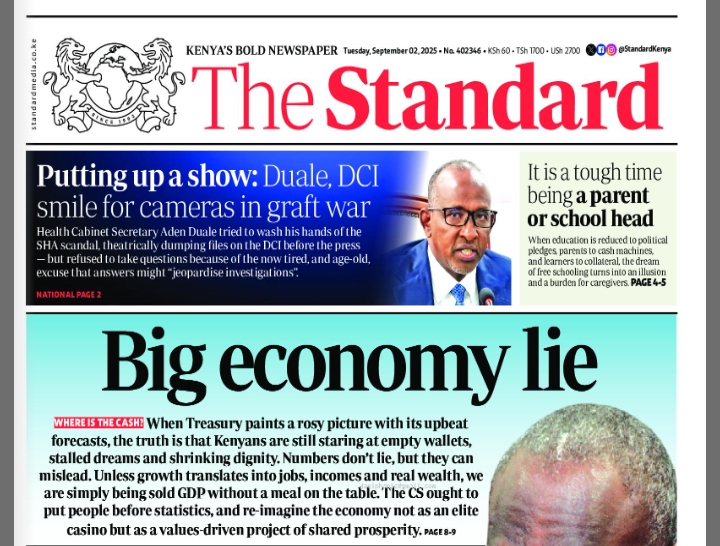
Analysis Tone and Perspective Review Of The Standard Newspaper
TONE
The tone of The Standard is predominantly critical and accusatory, holding the government to account for perceived failures in economic management, governance, and service delivery. It adopts a tone of advocacy for the common citizen, emphasizing the stark contrast between official statistics and the harsh financial realities faced by Kenyans. A tone of hopeful inspiration is reserved for stories of individual or institutional progress, providing a counterbalance to the prevailing narrative of systemic dysfunction.
TRACK
The newspaper’s track is firmly focused on socio-economic and political issues that directly impact the welfare of ordinary Kenyans, such as the cost of living, corruption, and access to education. It consistently tracks governmental performance and policy implementation, highlighting gaps between promise and practice across various ministries and county governments. The track also includes celebratory stories of national achievement in sports and pioneering educational initiatives, ensuring a balance between criticism and positive national coverage.
FRAMING
The stories are framed through a lens of social justice and equity, consistently positioning the citizen as the victim of poor governance, economic mismanagement, and systemic corruption. The government’s actions are often framed as out-of-touch, prioritizing abstract figures and public relations over tangible public benefits and accountable leadership. Conversely, positive developments are framed as triumphs of individual or institutional initiative, often achieved in spite of, rather than because of, government systems.
EDITORIAL AGENDA
The editorial agenda is clear in its demand for a people-centered economy, transparent governance, and accountable leadership that prioritizes public welfare over political or elite interests. It advocates for the enforcement of existing rules, such as the ban on illegal school fees, and for proper consultation and capacity building before implementing new systems like the e-GP. The agenda also promotes social progress, celebrating breaking gender barriers and advocating for the preservation of niche industries, while maintaining a critical eye on all branches of government.
CONCLUSION
In conclusion, this edition of The Standard presents a nation at a crossroads, grappling with deep-seated institutional challenges that hinder shared prosperity despite pockets of progress. The overarching conclusion is that true, felt economic growth is being stifled by governance failures, corruption, and a lack of meaningful public participation in policy-making. The paper ultimately calls for a fundamental re-imagining of governance to close the gap between official rhetoric and the daily struggles of citizens, advocating for a system that works for the many, not the few.