
Summary Of The Standard Newspaper
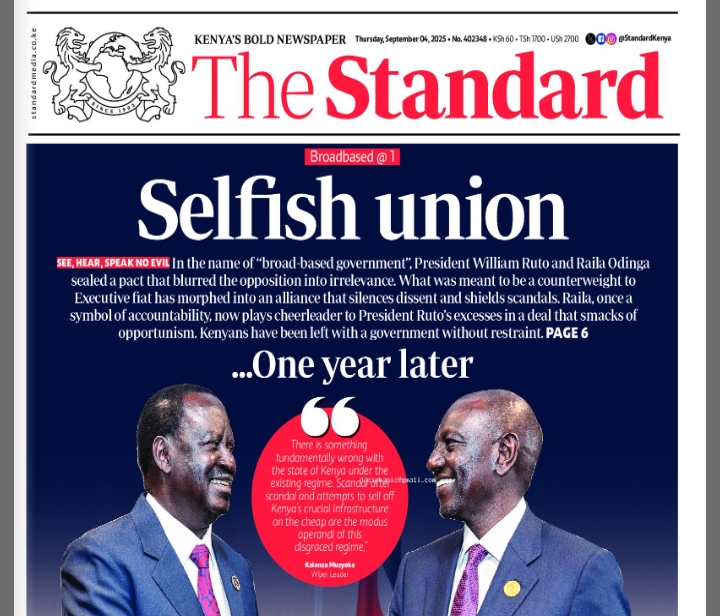
Page 1: Reports detail a political pact between President William Ruto and opposition leader Raila Odinga, which has created a “selfish union” and a so-called broad-based government. This alliance has effectively blurred the lines of opposition, silencing dissent and shielding the government from accountability over scandals and excesses. As a result, critics argue that Raila Odinga has become a cheerleader for the administration, leaving Kenyans with an executive power that operates without restraint.
Page 3: Reports confirm the presence of Jubaland forces from Somalia inside Kenya’s border, which has caused fear, led to the shutdown of schools and businesses, and prompted families to flee in Mandera. Political leaders are criticizing the government’s slow and uncertain response, with Interior Cabinet Secretary Kipchumba Murkomen stating the administration could not confirm the invasion. Mandera Senator Ali Roba and other lawmakers are demanding immediate action from President Ruto and the Kenya Defence Forces to address the incursion and defend the country’s sovereignty.
Page 4: Reports indicate the High Court in Nairobi has issued an order protecting a gynaecologist and her fertility clinic from arrest or prosecution in a case related to the skin colour of a surrogate baby. The order prevents the police and DCI from demanding surrogacy agreement records as part of an alleged human trafficking investigation that was initiated after a couple complained. Justice Bahati Mwamuye directed the authorities to refrain from any action against Dr. Sarita Sukhija or her employees at the Myra In Vitro Fertilisation Clinic.
Page 5: Reports from the Controller of Budget reveal that the Office of the President, State House, and Parliament spent billions of shillings on domestic and foreign travel amidst a national fiscal crisis. This excessive expenditure on hospitality and travel occurred despite President William Ruto’s public calls for government austerity and while critical sectors like education and health are severely underfunded. The report highlights a stark contradiction between the administration’s stated priorities and its actual spending, with State House alone expending Sh2.2 billion on domestic travel.
Page 6: Reports indicate that the national government’s pending bills owed to businesses increased to Sh524.84 billion by June 2025, up from the previous year. This debt, comprising Sh404.3 billion from state corporations and Sh120.5 billion from ministries and agencies, has forced many companies to scale down operations or shut down entirely. The delay by a verification committee to address these arrears has fueled doubts about the Treasury’s commitment to resolving the chronic issue.
Page 8: Reports describe how the political pact between President William Ruto and Raila Odinga has eliminated effective opposition, creating a government without checks and balances. Since their partnership began in July 2024, Raila has transitioned from a vocal critic to a defender of the administration, muting his previous strong stance against state scandals and controversial policies. This silence has extended to his allies in Parliament, where oversight has diminished and dissent is discouraged, leaving the executive power largely unrestrained.
Page 9: Reports reveal a suspected Sh24 billion fraud at the Social Health Authority (SHA), an agency central to President Ruto’s universal health coverage program, reopening a history of corruption at the Ministry of Health. The scandal reinforces the ministry’s notorious “Mafia House” nickname and highlights a pattern where systemic failures lead to massive losses of public funds under the watch of supposed oversight bodies. Instead of facing punishment, individuals linked to such corruption are often rewarded with promotions and political protection, perpetuating the cycle of graft.
Page 10: Reports indicate a significant rise in muggings within Nairobi’s Central Business District, with incidents occurring most frequently on weekends and during early morning or evening hours in deserted areas. Key hotspots include the National Archives, Kenyatta Avenue, the Moi Avenue and Mama Ngina junction, Aga-Khan walk, and the Bus station. The muggers, described as young and armed with knives, target individuals using mobile phones and are known to become violent if victims resist.
Page 16: Reports confirm the death of 41-year-old Kenyan police Corporal Kennedy Mutuku Nzuve, who died in a vehicle accident on August 31, 2025, while serving as part of the Kenyan mission in Haiti. His family in Kiambu county, including his mother and his daughter who is preparing for her Form Four exams, is grieving and seeking his swift repatriation for burial. Described as a supportive and loving father, Corporal Mutuku was proud of his service and had last spoken to his family just days before the fatal incident.
Page 17: Reports indicate that some elected leaders in Kiambu County are being accused of fabricating health sector crises and spreading malicious information to politically undermine the county government. The County Executive for Health, Dr. Elias Maina, alleges that these politicians have stage-managed incidents, such as circulating false stories and photos of patients, to falsely portray the health system as collapsed. This political theatrics has drawn sharp criticism for exploiting vulnerable individuals and misinforming the public to attack the county leadership.
Page 40: Reports preview a crucial World Cup qualifier match between Kenya’s Harambee Stars and Gambia, with both teams having very slim chances of advancing to the 2026 tournament. Gambia’s coach, Jonathan McKinstry, acknowledged the difficulty of facing Kenya at a hostile Kasarani Stadium, noting the team’s improved fighting spirit under coach Benni McCarthy. A victory would lift Kenya to nine points in the group, keeping their faint qualification hopes alive, while group leaders Ivory Coast and Gabon remain firmly in control of the automatic qualification spots.