
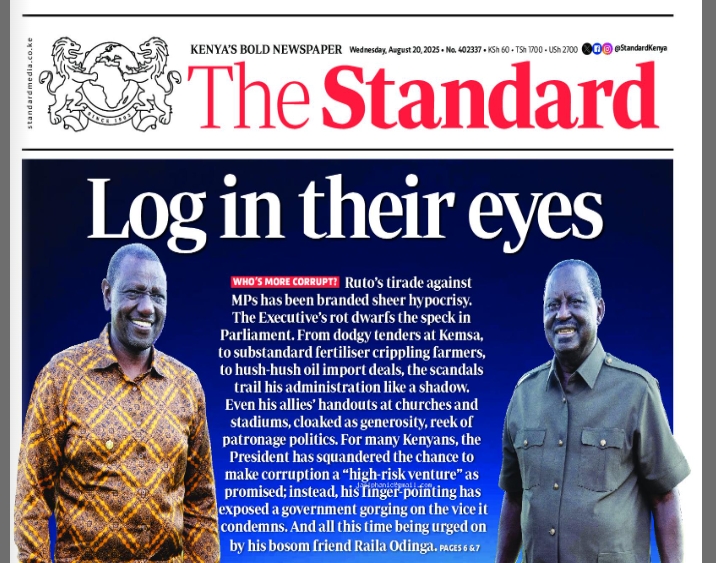
Analysis Tone and Perspective Review Of The Standard Newspaper -Aug 20,2025
TONE
The newspaper’s tone is predominantly critical and accusatory, particularly towards the Executive branch of government. It conveys a strong sense of disillusionment and betrayal, highlighting the gap between political promises and the reality of corruption and mismanagement. The language is assertive and evidence-based, using specific financial figures and direct quotes to substantiate its serious and condemnatory stance.
TRACK
The paper consistently tracks themes of governmental failure, corruption, and the human cost of poor governance. It meticulously follows ongoing scandals, such as the allegations against the President and the Kenya Power audit, while also tracking the resultant political fallout and institutional pushback from Parliament. Furthermore, it maintains its track record of covering human-interest stories that illustrate the dire consequences of these systemic failures on ordinary citizens.
FRAMING
The stories are framed to emphasize accountability and conflict, positioning the government as an entity that must answer to its citizens and other branches of power. The corruption narrative is framed not as a generic issue but as a specific failure of President Ruto’s administration, directly contrasting his rhetoric with his actions. Human-interest angles, like the canceled child’s surgery, are framed to personalize and highlight the devastating impact of abstract policy decisions and financial mismanagement.
EDITORIAL AGENDA
The editorial agenda is clearly focused on exposing graft and holding the powerful to account, positioning the paper as a watchdog against executive overreach and corruption. It advocates for robust parliamentary independence and institutional integrity, as seen in its coverage of senators and committee chairs challenging the President. The agenda also includes giving a voice to the vulnerable affected by poor governance, ensuring their stories are part of the national conversation.
CONCLUSION
In conclusion, this edition presents a nation grappling with a profound crisis of governance, where high-level corruption and political infighting are paralyzing effective administration. The overarching conclusion is that the government is failing in its core duties, from safeguarding public funds to ensuring basic services and justice for its citizens. The collective reporting paints a picture of a country at a crossroads, where institutions are pushing back against executive blame-shifting and the public bears the heaviest burden of these failures.